
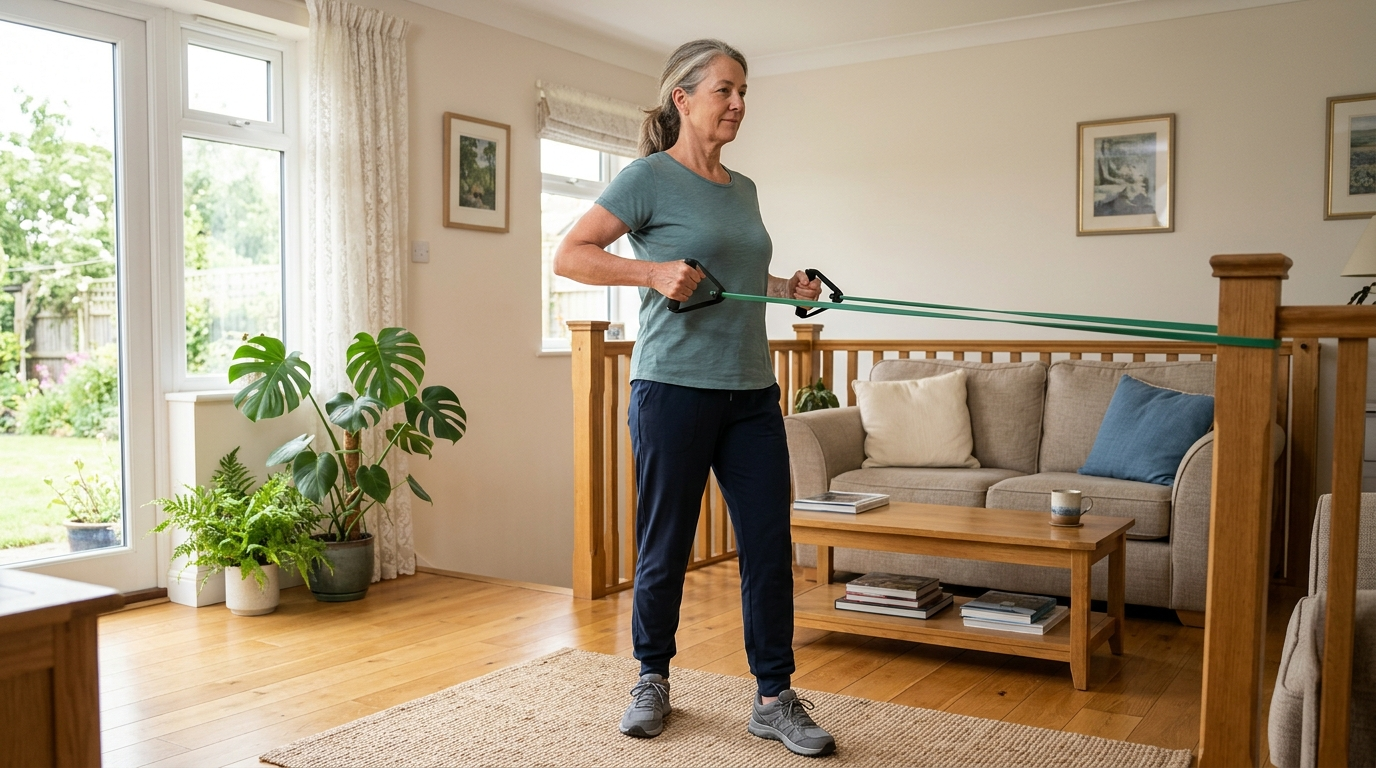
Strength training has acquired a rather formidable wardrobe. Barbells, weight machines, protein shakers and people doing things with ropes that look unnecessarily dramatic can make the whole business seem like a hobby you either embrace completely or avoid.
Fortunately, strengthening your muscles does not require any of that.
For most of us, the useful question isn’t how to build the perfect training program. It’s how much strengthening activity we need to support the ordinary things we want to keep doing — getting out of a chair comfortably, carrying shopping, climbing stairs, gardening, travelling and generally trusting our bodies to do their share of the work.
And the answer is more manageable than you might expect.
Two Minute Read
- Current Australian and international guidelines recommend muscle-strengthening activity on at least two days each week.
- Strength training doesn’t have to mean lifting heavy weights in a gym. Resistance bands, bodyweight movements, weights and some everyday activities can all challenge your muscles.
- Aim to work the major muscle groups across your week rather than concentrating only on arms or legs.
- You don’t need an elaborate program. Current evidence strongly supports consistency over unnecessary complexity.
- If you’re starting from very little, begin with a manageable amount and build gradually.
- Strength work complements walking and other aerobic activity rather than replacing them.
- From age 65, activities combining strength with balance and functional movement become particularly valuable.
Why strength deserves some attention
Walking is excellent exercise, but it doesn’t do everything.
Your muscles respond to being asked to work against resistance. That resistance might come from a dumbbell, an exercise band, your own body weight or an object you’re moving safely.
Regular resistance training can improve muscular strength and physical function. That’s useful not because everybody needs impressive muscles, but because strength underpins a surprising amount of everyday independence.
A stronger pair of legs can make standing from a low chair easier. Strength through the hips and legs helps with stairs. Upper-body strength matters when carrying bags, moving household objects or lifting something onto a shelf.
This is fitness with a practical job to do.
So, is twice a week really enough?
For general health, two or more days a week is the useful number to remember.
The Australian Government’s current movement guidelines recommend muscle-strengthening activities on at least two days per week for older adults. World Health Organization guidance similarly recommends strengthening activities involving all major muscle groups on two or more days each week.
That doesn’t mean two days is a magical threshold below which nothing counts.
If you currently do no strengthening activity, doing some is a meaningful improvement. The American College of Sports Medicine’s 2026 position stand emphasises that the biggest step is moving from no resistance training to some resistance training, and that complicated programs aren’t necessary for most healthy adults.
So if two complete sessions seem unrealistic at first, don’t use the guideline as a reason not to begin.
Start somewhere.
What actually counts as strength training?
A useful strengthening exercise makes your muscles work harder than they normally do.
That could include:
- standing up repeatedly from a sturdy chair;
- wall, bench or modified push-ups;
- squats or partial squats suited to your ability;
- resistance-band exercises;
- lifting dumbbells or other appropriate weights;
- step-ups;
- some forms of Pilates or similar resistance-based exercise.
You don’t necessarily need a gym. ACSM’s current evidence review supports resistance training using elastic bands, bodyweight exercises and home-based training as legitimate options.
What matters is that the movement provides enough resistance to challenge the muscles involved.
That distinction matters. Carrying shopping may certainly require strength, for example, but an occasional heavy bag isn’t quite the same thing as regularly and progressively challenging your muscles in a controlled way.
You don’t have to make every session complicated
Strength programs can become extraordinarily detailed once you start reading about sets, repetitions, loads, rest intervals and training techniques.
Those details can matter when somebody has a particular performance goal. They matter rather less when complexity becomes the reason you never begin.
For general health, think first about covering the major muscle groups:
- legs and hips;
- back;
- abdomen and trunk;
- chest;
- shoulders;
- arms.
You don’t need a separate exercise for every muscle you possess. Many simple movements work several areas at once.
A sit-to-stand exercise, for example, asks quite a lot of your legs and hips without requiring you to learn the workings of a gym machine.
The aim isn’t to create the most sophisticated program. It’s to create one you’re likely to repeat.
How hard should strength exercise feel?
Strengthening exercise should feel like work, but discomfort isn’t the objective.
Towards the end of a set of repetitions, the muscles you’re using should generally feel challenged. Your movement should still be controlled and your technique shouldn’t fall apart simply to complete another repetition.
If an exercise feels extremely easy indefinitely, it may eventually stop providing much of a strengthening challenge. That’s where gradual progression comes in.
You might progress by adding a little resistance, doing another repetition, using a slightly more demanding version of the movement or increasing the amount of work over time.
Small changes count.
There is no prize for progressing so quickly that you’re too sore to move comfortably for the next three days.
Recovery is part of the plan
Muscles need an opportunity to recover from strengthening exercise.
That’s one reason two non-consecutive strength days can work conveniently for many people — Monday and Thursday, for example, rather than trying to squeeze everything into consecutive days.
Some temporary muscle tiredness after unfamiliar exercise can be normal. Sharp pain, chest pain, severe shortness of breath, dizziness or symptoms that concern you are different and shouldn’t simply be pushed through.
If you have a health condition, significant pain, a recent injury, have been inactive for a long period or aren’t sure whether a particular exercise is appropriate, a doctor, physiotherapist or appropriately qualified exercise professional can help you choose a suitable starting point.
Strength and balance work well together
Strength is only one part of physical function.
For adults aged 65 and over, current Australian recommendations include functional activities targeting mobility, balance and coordination on three or more days each week, alongside strengthening activity. WHO guidance similarly recommends varied activity emphasising functional balance and strength on at least three days per week for older adults.
That doesn’t necessarily mean creating another three formal workouts.
Some activities can contribute to more than one goal. Exercises involving controlled standing, stepping and changes of position can challenge both strength and balance.
If you’d like a simple indication of how your balance is doing, our article on what a 10-second balance test can tell you provides a sensible starting point.
The point isn’t to pass tests or compare yourself with somebody else. It’s to keep giving your body opportunities to practise the abilities you want it to retain.
What if you haven’t done strength training for years?
Then your starting point should reflect that.
Not what you did at 35. Not what somebody beside you can do. Not what an online workout assumes everybody should manage.
Your starting point.
WHO guidance specifically encourages inactive people to begin with small amounts of physical activity and gradually increase the duration, frequency and intensity.
That might mean beginning with a handful of controlled chair stands and wall push-ups rather than a 45-minute workout.
Once that feels familiar, you can add a little.
The first few weeks are partly about learning movements, discovering what feels comfortable and establishing a routine you can actually maintain.
Consistency has a habit of looking rather unimpressive from one Tuesday to the next. Over months, it becomes considerably more interesting.
Don’t forget the movement you already enjoy
Strength training shouldn’t elbow everything else out of the diary.
Walking, cycling, swimming, dancing, gardening and other enjoyable movement offer benefits of their own. Current physical-activity guidelines combine aerobic activity, strengthening work and — particularly for older adults — functional and balance activities.
Think of strength work as another part of the mixture rather than the new activity that has to dominate your week.
Two manageable sessions can sit alongside the movement you already enjoy.
And if those sessions happen at home with a resistance band rather than beneath the fluorescent lights of a gym, the muscles won’t lodge a complaint.
Key Takeaways
- Muscle-strengthening activity on at least two days per week is a useful evidence-based target.
- You can train effectively at home; gym membership and sophisticated equipment aren’t essential.
- Work the major muscle groups across your routine rather than focusing on one area.
- Strength exercise should challenge your muscles without turning pain or exhaustion into a goal.
- Increase the challenge gradually as movements become easier.
- Strength complements aerobic activity and, particularly later in life, balance and functional movement.
- A modest routine you repeat is more useful than an ambitious one you abandon.
👣
One Small Step
Choose one simple strengthening movement you can do safely — perhaps controlled sit-to-stands from a sturdy chair — and try a small, comfortable set today. The aim is simply to establish a starting point, not to prove anything.
Sources & Further Reading
- Australian Government — Recommendations for older adults aged 65 and over
- World Health Organization — Physical activity and sedentary behaviour recommendations for older people
- World Health Organization — Physical activity and sedentary behaviour: a brief to support older people
- American College of Sports Medicine — 2026 resistance training position stand overview
- American College of Sports Medicine — Effective resistance training guidance
A Note About Your Health
The information provided in this article is intended for educational and informational purposes only and should not be considered medical advice. It is not a substitute for professional diagnosis, treatment or advice from a qualified healthcare provider.
Always consult your doctor or another appropriately qualified health professional before making significant changes to your diet, exercise routine, medication, supplements or lifestyle, particularly if you have an existing medical condition or take prescription medication.