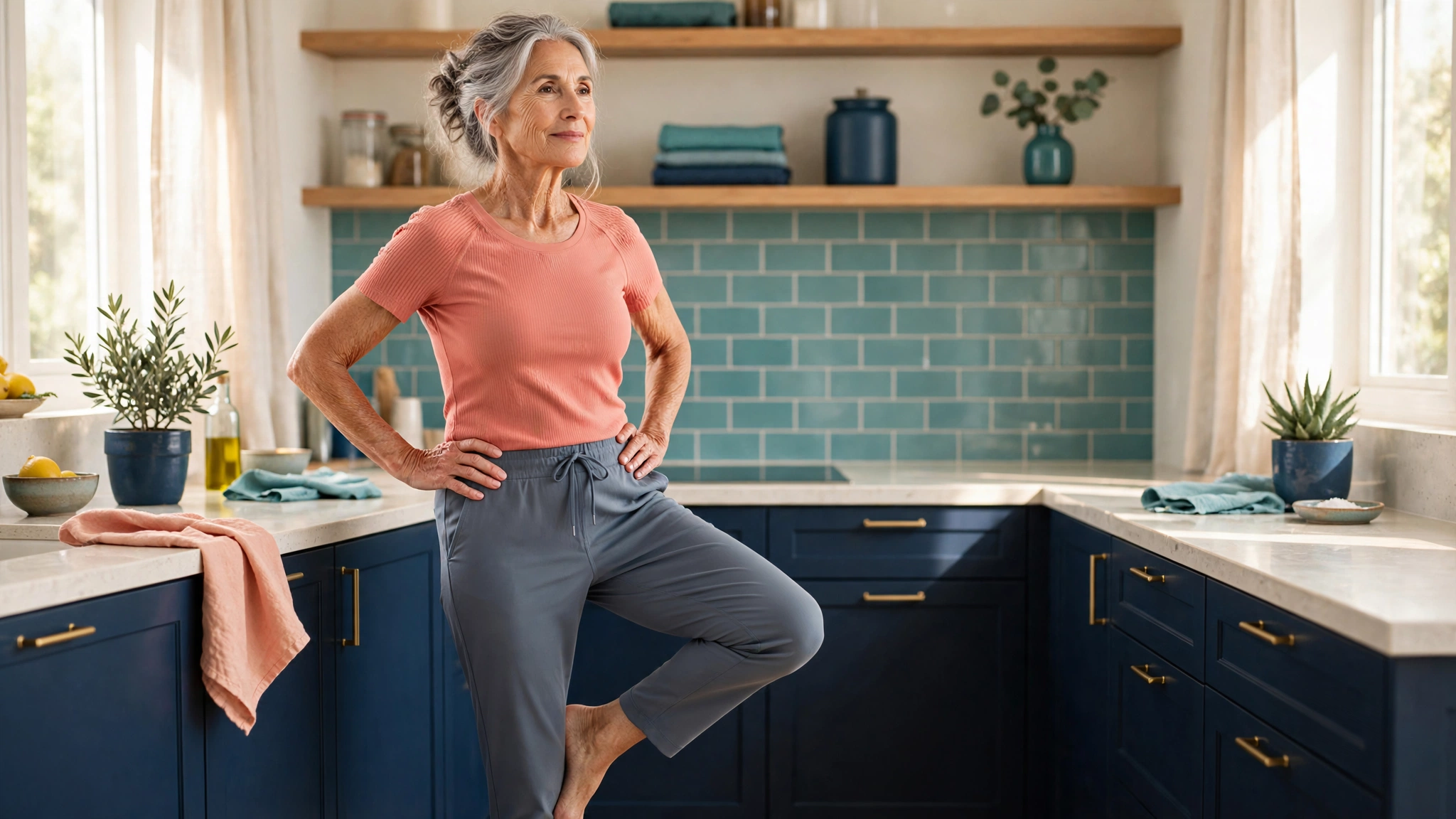
You have probably heard the terms “chronological age” and “biological age” thrown around. Chronological age is simply the number of birthdays you have celebrated. Biological age, on the other hand, is a measure of how well your body is actually functioning compared to that number.
While a true biological age assessment requires blood tests and clinical analysis, there is a surprisingly reliable, entirely free way to gauge your functional biological age right at home. It requires no special equipment, takes less than a minute, and is backed by years of gerontological research.
It is the One-Legged Balance Test.
Why Balance Matters More Than You Think
When we think of fitness, we often picture gym memberships or long runs. But balance is the quiet foundation of independent, active living. It requires a seamless conversation between your eyes, your inner ear, your muscles, and your nervous system.
Research has consistently shown that the ability to maintain a steady, one-legged stance is strongly linked to overall vitality. A notable study published in the British Journal of Sports Medicine found that an inability to stand on one leg for 10 seconds in later life was linked to a higher risk of all-cause mortality. Conversely, good balance indicates strong core stability, healthy joint function, and a responsive nervous system—all hallmarks of a younger biological age.
How to Take the Test Safely
Safety first. Please do this near a sturdy surface, like a kitchen counter or the back of a solid chair, so you can catch yourself if needed. Remove any tripping hazards, and wear flat, supportive shoes (or do it in your socks on a non-slip floor).
- Stand tall with your feet together and your arms relaxed by your sides.
- Shift your weight gently onto your dominant leg.
- Lift your non-dominant foot off the floor, resting the sole against the inside of your standing ankle or calf (do not rest it against your knee).
- Place your hands on your hips to remove any arm support.
- Start a timer and see how long you can hold this position without your lifted foot touching the ground, your hands leaving your hips, or your standing foot shifting.
- Repeat on the other leg.
What Do the Results Mean?
Remember, this is not a medical diagnosis. It is simply a practical baseline to help you understand your current functional fitness.
- Under 5 seconds: Don’t be discouraged. Balance is a skill, and like any skill, it can be improved. This result simply means your nervous system and stabilising muscles would benefit from some gentle, regular practice.
- 5 to 9 seconds: You have a moderate foundation. With a little dedicated practice, you can build this up to the optimal range.
- 10 seconds or more: Excellent. This is the benchmark often associated with healthy, functional biological age. Keep up whatever you are doing, as your body is maintaining its stability well.
How to Improve Your Score
The brilliant news about balance is that it responds very quickly to practice. You do not need a gym.
- Brush your teeth on one leg: Use the sink for light support while you build the habit.
- Heel-to-toe walks: Walk in a straight line, placing the heel of one foot directly in front of the toes of the other, as if walking on a tightrope (hold a wall for support).
- Strength training: Stronger legs and core muscles provide a more stable platform for your balance to work from.
One Small Step
Today, while you are waiting for the kettle to boil, stand safely next to your kitchen counter and try the one-legged balance test. Just note your time. You do not need to fix anything today; simply establishing your baseline is a powerful, proactive step toward staying well and staying active.